Summer is in full swing and, throughout the season, in cooperation with external specialist XY, we are bringing you our new Funds for Founders series, which will guide you through the world of qualified investors funds (QIFs).
The series follows the natural journey of a founder: from the initial question, “Do I need my own fund?” through to the fund’s day-to-day operation, management and growth. We will gradually look, among other things, at how Czech QIFs compare with other jurisdictions, as well as tax aspects, fees and the practical management of a fund.
Phase 0 — Before You Decide
What Is a QIF and When Does It Make Sense to Have Your Own Fund
“A fund is not just for billionaires. It is a legal and credible vehicle for managing assets or projects under one regulated umbrella — giving investors and yourself clear rules of the game.”
Key points
What is a qualified investors fund (QIF)?
- A regulated structure for collective investment. Several investors invest through one structure, professionally managed under a predefined strategy (real estate, companies, loans, securities, etc.).
- Subject to supervision. A QIF is registered with the Czech National Bank and has professional management, a depositary and an auditor. Credibility.
- For a defined group. It may not be offered to the public (retail). Only a qualified investor may invest.
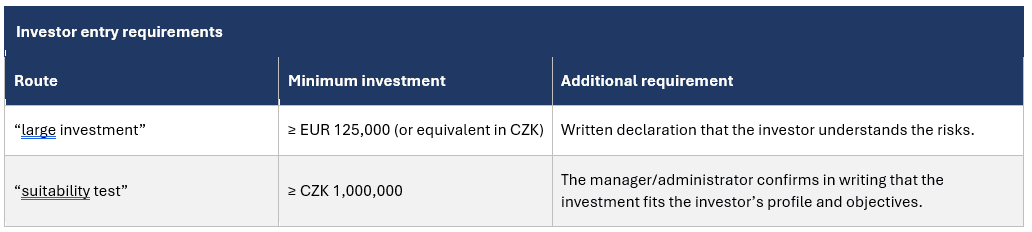
Who is a qualified investor (simplified under Section 272 ZISIF) — two routes:
When does having your own fund make sense (typical situations):
- You have projects/assets (real estate, companies, energy, etc.) and want to bring in investors through a clean, credible structure.
- You want to separate investors’ assets from your own, with rules, reporting and independent oversight — opening access to institutional and private capital.
- You are looking for an efficient tax regime for long-term appreciation
- You want to scale: gradually add strategies/projects as sub-funds under one umbrella
When does a fund NOT (yet) make sense:
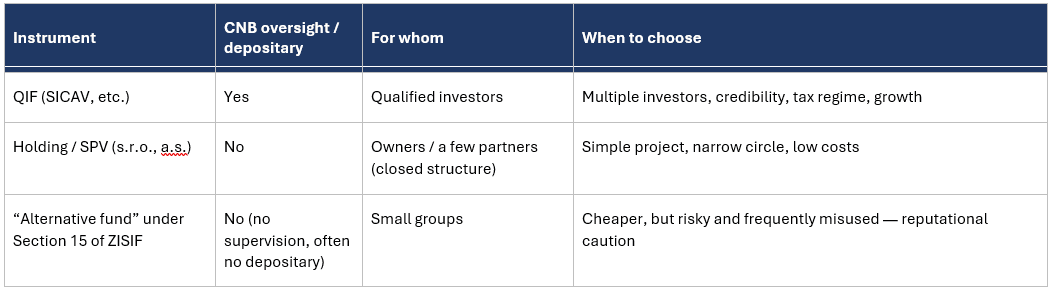
- You have one or a few small projects and up to 20 known investors. An ordinary SPV / holding or contractual co-investment is often cheaper.
- Target assets below approx. CZK 200 million and insufficient operating capital would mean the fund “eats up” the return.
- You want to offer it to the public / retail. A QIF cannot do this by its nature — it is for qualified investors.
Overview: QIF vs. alternatives