
Legal form: SICAV with / without sub-funds, share classes
“SICAV is a flexible vehicle, and its sub-funds enable efficient separation of investment strategies, asset-class risks, etc.”
Key points
SICAV (a joint-stock company with variable share capital) is currently the most common form of a QIF. Key business features:
- Variable capital: investors enter and exit through subscription and redemption of investment shares, without any amendment to the constitutional documents. Investors do not have voting rights (with minor exceptions).
- Founder shares vs. investment shares: the founder holds founder shares (management/voting rights), while investors hold investment shares (share in returns/redemption). This is the basis for setting control and remuneration.
- Investment share classes: can be flexibly structured as needed (typically allocation of fund returns according to the nature / size of the investment)
- Segregated assets: the fund’s assets are separated from the assets of the manager and the founder. Investor protection and credibility.
Structure: SICAV without sub-funds vs. with sub-funds Without sub-funds (simple SICAV):
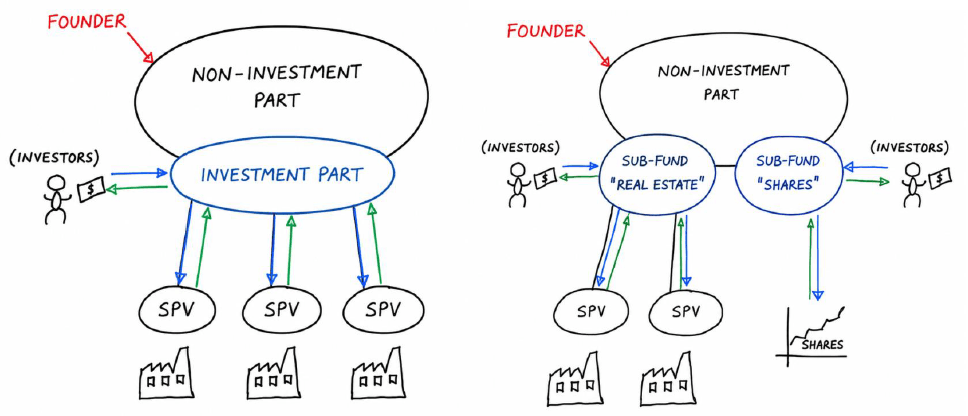
- One strategy, one pool of assets.
- Suitable when you have one type of asset and do not plan to add unrelated strategies soon.
- For the fund to be taxed at the 5% corporate income tax rate (basic fund), real estate cannot be held directly by the fund, but through an SPV under the fund.
With sub-funds (umbrella):
- Segregation of sub-fund assets: liabilities of one sub-fund generally do not affect another. The risk of project A (in sub-fund A) does not threaten investors in project B (in sub-fund B).
- Scalability: you can launch an additional strategy as a new sub-fund — faster and cheaper than establishing an entirely new fund.
- Different investors, different assets under one brand.
Share classes / multiple classes can be created within the fund or sub-fund, differing for example in:
- currency, fees, minimum investment, redemption rights;
- return priority: one class for investors (e.g. preferential return – PIA); another performance class for the founder (VIA) — an elegant way to direct the performance fee.
Note: mutual fund (does not have legal personality; it is a pool of assets managed by a management company, investors hold unit certificates).
- It works, but for founders SICAV is usually more flexible (its own legal personality, easier work with share classes and sub-funds, clearer for investors, greater influence over operations).